Summer Story Sale

Hi Beautiful Campers!

I hope you’re all well, and staying cool. Whether you’re baking—I mean basking—by the lake, sheltering in the woods or just hiding out in the AC, I have some fantasy stories for you, to take you to cool, dark, interesting places. From June 23-27, these stories will be on sale on Amazon.

Wizards, Woods and Gods: Short Stories. $0.99
Twelve stories involving swords, sorcery, love, gods, assassins, shapeshifters, wizards, war…and a badass cat or two. 206 pages. “F.T. McKinstry writes in a way that involves all the senses. Highly recommended.”

The Sea Witch’s Bargain. This story is included in Wizards, Woods and Gods.
An ordinary hedge witch falls afoul of an ancient order of sorcerers. They know her secrets. They know her weaknesses. And she has something they want. To escape them, she must make a deal with a devious, vengeful monster that will most certainly get her killed, unless she uses all her wits and then some. 24 pages. “Grim, eerie, almost tangible world building.” Based on an excerpt from The Wolf Lords, Book 2 in The Fylking.

A Northward Gaze: A Novella. Free!
An old forest with a dark history. An old family with a lot of secrets. And a young woman who sees faces and creatures in the floral patterns of her bedroom wallpaper. When an unholy tryst with an elven lord and a series of grisly, unexplained deaths drive her into the labyrinth of a faerie curse put on her bloodline in a centuries-old crossroads bargain, she must sacrifice the dearest thing to her in all the world—or lose her life and serve the Unseelie Fae for all eternity. 124 pages.

These stories are all available on Amazon and Kindle Unlimited.
Enjoy!

© F.T. McKinstry 2024. All Rights Reserved.

Valentine’s Day Epic Book Sale

In my never-ending quest to uphold a reputation, I tend to look upon Valentine’s Day with all the warmth of the Winter Warlock. Try to give me a choo-choo and I will sic my monster trees on you.


The thing is, beneath my wintry fortress, I can be a bit of a softie. Despite my curmudgeonly self, I appreciate the people in my life: friends, family, social media peeps, geeks and readers alike. I am grateful.

So, I’ve decided to show my love with a book sale. Depending on what you’re into, it might not compete with chocolate and roses, but hey, that shit’s expensive (especially on Valentine’s Day). A story lasts forever. Dark stories about wizards, warlords, fiends and shadows last even longer. Heh.

February 13-15, all the books in my epic fantasy series the Chronicles of Ealiron will be on sale on Amazon. The first four of these books are normally $4.99.

Want some more chocolate? A Northward Gaze will also be free! In this gothic fantasy tale, an old forest with a dark history, a tryst with an elven lord and a series of grisly, unexplained deaths drives a woman into the labyrinth of a faerie curse put on her bloodline in a centuries-old crossroads bargain.

 
See? Softie. And choo-choos are cool–especially those elven-made ones.

Love you all. Stay safe and well.

© F.T. McKinstry 2023. All Rights Reserved.

Otherworld Deviltry and the Crossroads Metaphor

One of the staples of folklore, legends and fairy tales is making deals with the Powers That Be (Rumpelstiltskin, The Girl without Hands, Nix by the Mill Pond). This might be motivated by curiosity or longing; but most often, it’s an attempt to escape a desperate situation. This can be something as simple as praying for deliverance in return for, say, a promise to be a better person next time. (Good luck with that.)

Or, it can take the shape of a classic deal with the devil, and we all know what that will get you. Bad things.

Sometimes, if you’re not only desperate but close to the veil, the otherworld might seek you out. This happens to the protagonist of The Sea Witch’s Bargain, a short story about an ordinary hedge witch with some heavy otherworld connections. While on the run from a brotherhood of sorcerers, she unwittingly enters the lair of a sea witch, a devious, malevolent creature who tricks her into performing a dangerous task in return for help in escaping her situation. This is non-negotiable, of course.

Any divine entity worth its salt will guide you to find your own strength because let’s face it, one desperate situation often leads to another, and the universe isn’t your personal wizard. But why summon your own strength when you can play with fire and summon something from the otherworld? That’s easier and much more exciting. You’ll get what you ask for, even if it’s stupid. And you might even be happy for a time—until your payment comes due.

An otherworld being like a demon, a jinn or an elf serves itself. It will look upon your troubles with cavalier disdain and will demand a high price for its services, a price it won’t bother to mention, or sounds simple enough, or couldn’t possibly be as bad as your original problem. Thou fool! These beings are tricky and they don’t lose. And, well, you signed in blood on the dotted line, didn’t you.

The Crossroads

Crossroads symbolism appears in ancient religions, medieval folklore and hoodoo (Faust, Robert Johnson). The place where two paths meet is liminal, like a gate, the border of a forest, a well, a cave, etc. These places hold power because they are between the worlds, a point of transition. They are also frequented by beings on the other side who are looking for a foothold in this world. Tales abound of idiots who use crossroads to summon otherworld entities for personal gain. This usually involves a sacrifice, whether it is something the summoner offers up, is demanded by the summoned, or both.

While folklore advises steering clear of crossroads, it is a powerful psychological metaphor. We’ve all reached crossroads in our lives, where we must choose a path that involves letting go of something we’re attached to. This could be an old pattern, an outworn belief, something like that. And who hasn’t tried wriggling out of doing that by bargaining with one’s demons? Those kinds of choices can bind us in unhappy situations for years.

My original idea for A Northward Gaze involved a woman in an old manor house who sees faces and shapes in the floral patterns of her bedroom wallpaper. As darkness unfolds, however, she discovers a devastating family curse that began with a three-centuries-old crossroads bargain with the Elven Fae. Beautiful, terrible, inscrutable and utterly seductive, the elves will continue their unholy rampage unless she gives up the one thing most dear to her in all the world. Because the most powerful choices require the greatest sacrifices.

For examples of what not to do on a crossroads, you can read A Northward Gaze on Amazon for much cheaper than an elf would charge you. Enjoy…and be careful what you wish for.

© F.T. McKinstry 2023. All Rights Reserved.

The Metamorphosis of a Book Cover

Earlier this year, I released a novella called The Crossroads Bargain, a gothic fantasy tale about an old forest with a dark history, a tryst with an elven lord, a lot of unexplained deaths and disappearances, and a faerie curse cast in a centuries-old crossroads bargain.

I created the cover art in the usual way. But for some reason, it unsettled me; it wasn’t quite what I was looking for. There were nervous whispers. I brushed them aside, knowing full well how reckless that is.

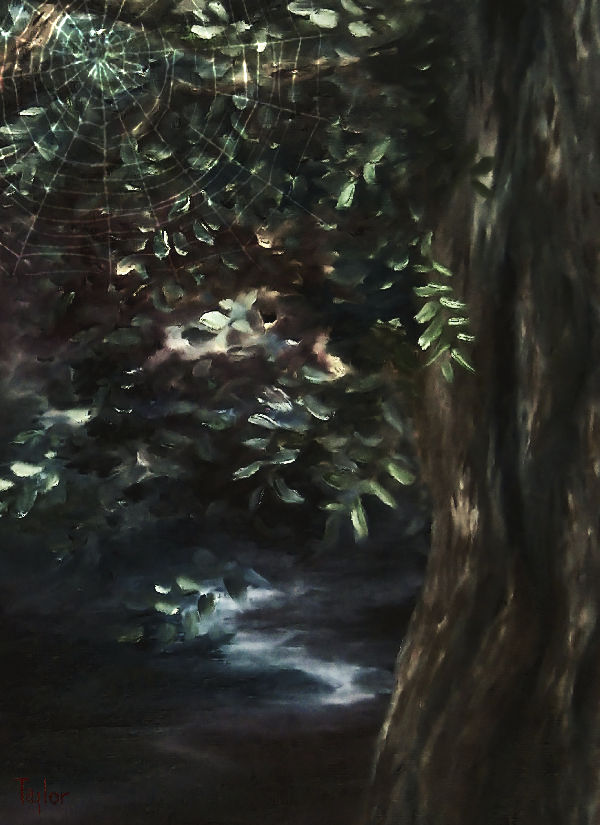
Just recently, I did a painting of a scene from the book, in which our protagonist, a sensitive, tormented sort, fades into the faerie realm and there sees the hall of an elven lord tucked into the forest. As I worked on this, a calm whisper suggested that it might make a good cover image.

Okay but I’m keeping that spiderweb.

Then, I suddenly thought of a title, from a saying in the story that describes what to do on a crossroads if you want to summon something from the otherworld:

A northward gaze; a wish as clear as a mountain stream; and a willingness to sacrifice the unimaginable.

Yeah, that little bit of advice causes all manner of horrors, by the way. But never mind that. My new cover came together so beautifully, I decided to change it. It captures the vibe of the story well.

A Northward Gaze is now available on Amazon. Oh, and about those crossroads instructions. Don’t try that shit at home.

© F.T. McKinstry 2023. All Rights Reserved.

New Cover Art and a Freebie

Happy New Year!

For a while now, I’ve had this dark little wolf in my head. Well, ok, my mind is full of all kinds of wild things at any given time–but this guy needed a furever home. So, after painting him, I put him on the cover of one of my books: Raven of the West, a standalone short story that’s part of the Chronicles of Ealiron.

The protagonist of this story is named Urien. He belongs to the highest order of the Keepers of the Eye, a hierarchical order of wizards who maintain balance in the world of Ealiron. Among other things, Urien can shapeshift into flora, fauna, earth, or fog, and he can cast an apparition or merge with the minds of gods. For years, he has haunted the fringe after having loved and lost a powerful wizard on the verge of ascension. But such secrets do not hide well, and when he delves into the darker powers at the bidding of a shady priestess with a hidden agenda, Urien finds himself facing the loss of everything he loves.

To celebrate my lupine invisible friend, Raven of the West will be FREE on Amazon, all day Saturday, January 7. This story is around 60 pages long, gives a rich, detailed picture of the wizards’ realm in Ealiron, and delves into all kinds of unsavory things like witchcraft, heartbreak, vengeance and disasters at the hands of the powerful.

Dark and darker. But fear not! Light always follows, and the days are getting longer now.

Raven of the West on Amazon

© F.T. McKinstry 2023. All Rights Reserved.

A Northward Gaze, A Novella

Previously published as The Crossroads Bargain by F.T. McKinstry.

Elspet’s mother died between the worlds, staring with eyes of lily white. A common occurrence in their bloodline, it is said. Denied a grave in hallowed ground, she is now only a whisper in the dark forest that borders the estate.

Grieving amidst a turbulent household of superstitious servants, the mysterious departure of her father, and an ambitious aunt with a draconian agenda, Elspet begins to see faces and shapes in the floral patterns of her bedroom wallpaper. Only she knows the reason for the series of grisly, unexplained deaths that follow her seduction by the beautiful elven lord who appears to her amidst the faded leaves.

What Elspet doesn’t know is the high cost of consorting with the Fae. For not even her mother’s books, the village witch, or the Fae themselves can stop her inexorable descent into the labyrinth of a faerie curse put on her bloodline in a centuries-old crossroads bargain—a curse she can only end with blood magic and the name of her lover’s most terrible enemy.

Novella, 125 pages
Second edition

Amazon

© F.T. McKinstry 2024. All Rights Reserved.

Tolkien Meets Poe

I am a passionate and dedicated fan of high fantasy; that is, any world other than this one and preferably one that smacks of a fairy tale, though not in a wholesome way. You know, like those old, dark Irish or German fairy tales that are not written for children. Beautiful things cast long shadows, and the summit is never far from the abyss kind of thing. Think J.R.R. Tolkien meets Edgar Allan Poe.

I started reading these authors roughly around the same time, when I was a kid in the 70s. Tolkien changed my life, I’ll just say that. Among other things, Poe’s short stories and a steady diet of Dark Shadows messed me up properly and got me hooked on Gothic Horror.

So this kind of crept up on me recently, the way the universe sometimes gives you a bitch slap so you’ll recognize what you’ve been looking at all along. While I love Gothic Horror, especially the supernatural–ghosts, werewolves, vampires, witches and the like–I never sat down and tried to write something like that, not specifically. But it was there nonetheless, slinking around in my work like a shadow in the corner of my eye.

Then this happened: A story flashed into my head. It was right out of one of those 60s pulp Gothic Horror novels, with a voluptuous sex kitten in a white nightgown fleeing over the moors from a black castle on the hill. It also featured the kind of fairytale lore I like to write into high fantasy novels. Yeah. My subsequent internal dialogue went something like this:

Writer me: I don’t know how to write this stuff.
Smarter me: You’ve been writing this stuff for years.
Writer me: Rubbish. This isn’t fantasy.
Smarter me: Um. It has elves in it.
Writer me: So. He’s not–
Smarter me: He’s a fucking elf. Beautiful, moves between the worlds, enchanting, seductive, and sneaky. So he’s not from the House of Fëanor, big deal.
Writer me: It’ll suck. You suck.
Smarter me: Whatever. Get to work.

So I did. It’s a novella called A Northward Gaze. A manor hall bordering an old forest with a dark history, a family curse, a string of grisly, unexplained deaths and a fey young woman who sees otherworld beings in the floral patterns of her bedroom wallpaper. Spoiler alert: Our aforementioned elf is one of them and he’s up to no good. Well, maybe. Maybe not. The Fae are tricky like that.


© F.T. McKinstry 2023. All Rights Reserved.

The Rise and Fall of Lovely Sentences

Redcap. One of the most malevolent beings of the Otherworld, the goblin liked to tease Twigs with trickery, such as leaving a fetid bouquet of her mother’s favorite flowers on the steps, or offering deadly mushrooms for a soup, laughing as she refused. But as surely as the sun set each day, the wicked creature would have something far darker in mind, something that would result in a big enough puddle of blood in which to soak its cap. – From Masters of the Veil, Book Three in The Fylking

One of the grimmest realities of writing is the fickle nature of words. Sometimes, a sentence, phrase or passage comes out of the void on an angel’s wings and reminds us why we do this. And we need that reminder. Because most of the time, we have no idea why we do this.

A written work such as a novel is an ever moving, flowing being with its own agenda. Not every sentence has its place in the overall scheme of things, no matter how pretty it is. If you’re good at editing–and by that I mean you are a cold, merciless bastard–you’ll get wise to this. Sometimes, that beautiful sentence you thought of three months ago isn’t quite so beautiful anymore. It doesn’t fit, it’s irrelevant, purplish or flawed, and you would be a vain little fop to leave it in there. Your editor will surely cut it–because there’s that other thing…oh yeah, readers. Just because you think it’s a beautiful sentence doesn’t mean they will. Someone might read it, yawn and think, “What rubbish.” So there’s that.

This is the kind of thing that drives authors to drown themselves in scotch and spend the night sobbing and pissing in a gutter somewhere.

But there is hope. Your ability to bring up that beautiful sentence will allow you to bring up another, and another, and on, because creativity is infinite and ever-expanding. It is always fresh because things are constantly dying and falling away to make room for other things in a much greater picture. Just look at nature. It keeps growing, cycling and expanding, and it is always what it is. Writing is like that.

So be warned: now and then, I might play the Insufferable Writer card and drop a sentence or three out here for you to read.

If nothing else, you’ll know I’m actually working on my next book.

© F.T. McKinstry 2022. All Rights Reserved.

Between the Worlds: Illness and the Forces of Wyrd

“Until you make the unconscious conscious, it will direct your life and you will call it fate.” ― Carl Jung

The Old English term wyrd is a feminine noun that generally means “fate.” In Germanic mythology, it is associated with one of the Norns, the weavers of fate, an arbitrary and implacable force to which all things, even the gods, are subject. In the classical sense, fate and destiny are somewhat dreary concepts. You can resign yourself and make the best of it, but the path is cast.

However, when contemplated from say, the point of view of seiðr, an Old Norse magical practice related to telling and shaping the future; or the quantum theory that everything is energy and all is connected, wyrd gets a bit more complex. From these perspectives, wyrd is an infinite, living web that exists in the present moment, where one choice can send a ripple that will touch the whole. Because we are mostly focused on the physical outcomes of these choices, it can be difficult to see the source, and easy to perceive the outcome as fated events over which we have no control.

Wyrd bið ful aræd. Fate is wholly inexorable. Or is it? When the sovereign power of choice is brought into the equation, wyrd becomes less of a spider web that hopelessly entangles us, and more of a loom on which a story is woven. A seiðr witch might change a fucked situation by peering into the web to discern the choices that created it, then plucking out the threads to allow new choices. Even when we’re affected by a choice someone else made, no matter how seemingly permanent the result, we can still make our own choices. The only thing that’s inexorable is the ripple on the web.

I’ve been sick for a long time. One of those arcane autoimmune conditions with unsatisfactory explanations, lots of theories and no cure. Life ruined from one day to the next kind of thing. The details don’t matter; these scenarios happen to people every day, and each instance is profoundly personal and subjective no matter what label gets superglued onto it.

One thing common with illness, however, is the experience of fate in all its classical glory, complete with cruel, capricious deities wielding bone needles as they cast their empty gazes over the fallen. Resisting fate is a hallmark of humanity. You’ll do anything to evade it. Fate will send you and your sword down, down to the roots of Yggdrasil for answers and there, you will drop to your knees and weep as you surrender to your own reflection in the pool.

The seiðr witch doesn’t work for free, in other words. You have to leave something behind.

And this brings me to the reason I’m talking about this on my author blog. Something happened to me by that pool, in the still point between the worlds, the spaces between the silvery strands of the web.

Stories. I had been writing for quite some time, wrestling the demons of depression — but not like this. Over the years that followed, I wrote seven novels, culminating with a series involving knitters, witches, warriors, seers, and a realm at war with the Otherworld. I wasn’t thinking about sickness, fate or my unconscious when I wrote those tales, but my heart was, and as I spun up worlds, a path appeared. I didn’t see it until years later. But it was there, an opening on the edge of an old dark forest, mysterious, kind of scary the way it snaked into the dappled shadows — but enchanting too, a portal tucked into the cold, materialistic battlefield of a modern-day illness.

Now I’m the one plucking threads. I’m making new choices. I’m spinning my own story one step at a time. I have no earthly idea where the forest path will lead…but I’m not evading it anymore.

© F.T. McKinstry 2021. All Rights Reserved.

Monsters, Art and the Voice of God

“In order to be created, a work of art must first make use of the dark forces of the soul.” – Albert Camus

I like dark things. When it comes to art, whether it’s literary, visual, musical or cinematic, I like it complex, subtle, not easily categorized and reeking of the shadow realms. It needs to affect me, to change me somehow. The most interesting thing about art is that the mystery exists in every form and genre, to whatever extent, like a ghostly silver thread that will lead you across the veil, should you be so inclined.

Dark Shadows (1966-1971). Vintage gothic horror at its finest…

This is not to say everything has to be high-end sophisticated. Far from it. I’ll trawl over that flashy, highly acclaimed drama film for a monster splatter flick every time, like a cat ignoring an expensive toy to play with a crumpled-up candy wrapper. I know monsters. They are the ultimate metaphor for the dank recesses of the psyche, where I like to play.

Consciousness loves contrast, as my beloved old psychologist used to say. If you face down the deepest, darkest abyss of your soul, you’ll break through to the other side. To the light. And vice versa: fly into the sun and you’ll plunge, flaming, into the chthonic depths. And again, and again. After years on this circus ride, I thought I was crazy. Surely, there were psychiatric terms for this, arbitrary labels to categorize the forces of existence, none of them nice. Here, take this pill to filter down that high amplitude, high frequency sine wave so you can be normal.

Yeah, fuck that. I don’t wanna be normal. But this was existential and so intense that I eventually fled to my aforementioned psychologist nonetheless, and it was she who posited the idea that these energies are inherently creative. Once I put that together, I became a maelstrom. I wrote books, painted, gardened, made music—all the things I’d always loved but never connected to the turbulence.

So the other night, I sat down to watch something. On a whim, I clicked on this movie I’d seen float by a zillion times: A Monster Calls. Cute little boy, coming of age, dying mother, invisible friend, etc. Typically, unless it’s a fairy tale or particularly well-done epic fantasy, my favorite stories about kids involve camping trips in remote places where a werewolf or an alien picks them off one by one. Not that I’m a curmudgeonly wicked witch or anything—well ok, I am but whatever—this is more about the power of metaphor. To make art, an innocent part of us must die.

Enter the implacable forces of the unconscious. I watched this movie as if my life depended on it. It went into my cleverly organized perception of who I am and demolished it like a wrecking ball. It hit every little thing. Rotten Tomatoes called this movie “trite and overly melodramatic.” There might have been a day when I thought that (doubtful). But not this day. When it was over, I fell apart like an old cicada shell, sobbing my guts out as I realized I had a choice to make around something I’d been hiding from for years.

A monster, if you will.

Ergo, art is necessary to existence—and ultimately subjective. Where one person sees dreck, another hears the voice of god.

© F.T. McKinstry 2021. All Rights Reserved.