Noble of the Wood

Apple Tree

A seed hidden in the heart of an apple is an orchard invisible. ~ Welsh Proverb

The apple is a sacred tree with a long, rich history of lore surrounding it. Aside from its fruit and many medicinal uses, it was revered in ancient times as a talisman of love, healing and immortality. In Norse mythology, the goddess Iðunn gave apples to the gods to keep them immortal. Loki stole them, but had to return them when the gods began to age. In English tradition, one apple was left on each tree after harvest as a gift to the fairies. Apple wood is the traditional choice for magic wands, and a branch laden with buds, flowers and fruit enables the possessor to enter the Otherworld. Considered the food of the dead, apples are associated with Samhain.

Apple trees grow wild in the woods where I live, and are particularly lovely in the spring, when they bloom. They tend to have dark, twisty trunks and low-sweeping, crooked branches, giving them a spooky air. A while back we bought a sturdy little tree and planted it in the back yard. It took years for the first blooms to appear. This year, it’s loaded with flowers. They smell incredible.

My apple tree has stories to tell. The winters are long and rugged up here, and the tree takes a beating, half buried in snow, torn by wind and ice. It split in an ice storm once, right down the middle and partway into the trunk. Heartbroken, I had the desperate idea of pushing it back together and holding it with electrical tape. This actually worked, if you can believe. It healed and now it’s strong as ever.

All kinds of creatures love the apple tree. The birds perch in it, and bees and hummingbirds love the flowers. In fall, I throw apples into the woods for the deer. Then there are my illustrious cats. The tree is easy to climb and perch in, and when the leaves are thick a cat can hide in it. Oh, and let’s not forget the spiders. Big, hobbit-eating spiders. They guard the tree and I’ve learned to keep my wits about me.

Oona in the Apple Tree

If all goes well this summer, we should have apples coming out our ears.

© F.T. McKinstry 2015. All Rights Reserved.

Writing and the Fairy Dust of Familiarity

Oona Creeping, by F.T. McKinstry

Oona Creeping

Consciousness dislikes chaos. Like cats pacing the borders of the yard, we tend to treat familiar things as safe and reliable. It gives us a sense of security. Given that familiarity makes a lot of arbitrary assumptions about reality, however, I personally think it’s an illusion, a convenient facade that makes it easier to deal with things. That’s natural enough, but when it comes to writing, one wants to be careful.

I recently finished a novel. It’s entitled Outpost, interestingly, a term that implies an unfamiliar place in some context or another. I finished it, revised it, edited, polished, washed and repeated until every word was as familiar as the lines on my hand. I’m weary of looking at the thing, truth be told. I put it in the capable hands of my editor.

Now things get interesting (note the mild sarcasm). Being familiar with one’s words is insidiously comforting. The process of writing, both mystical and miserable at the same time, has a way of making one’s work beautiful. Oh yes, the Universe is singing its brilliance because after all, suffering is noble. This is perilous, like being dusted with fairy glitter. You might think you’re looking at a nice green field with flowers and butterflies but those flowers have thorns, there’s a cat lurking in the shadows, the butterfly is headed for a spider’s web and the lambs are fleeing from an impending earthquake. Chaos is everywhere. This is what a good editor will see, because she isn’t strung out on fairy glamor or glossing over the goblins with a palette knife heaped with love and imagination.

Hemlock, by F.T. McKinstry

Hemlock

A useful exercise is to put the book aside for a time, let the fairy dust wear off and go back to it with a more objective perspective. This only works if you’re able to face reality without the high. If something nags you or doesn’t look right, don’t brush it off for fear of chaos by deciding it’s fine. It probably isn’t. It takes strength and courage to see through familiarity and let the work evolve.

These days, everyone is a writer. So I see a lot of things on the internet about How to Know If You’re A Real Writer. That’s a big topic fraught with nail biting. But I figure one of the criteria is knowing what it’s like to wake up from the fairy glamor with a nasty headache, a broken heart and some healthy skepticism.

In other words, chaos is a writer’s friend.

Little Tree, by F.T. McKinstry

Outpost Cover ArtOutpost, Book One in The Fylking.

A race of immortal warriors who live by the sword.
A gate between the worlds.
Warriors, royals, seers and warlocks living in uneasy peace on one side of the Veil.
Until now.

© F.T. McKinstry 2015. All Rights Reserved.

Pattern Sense

Dormouse

The heart is a powerful force, more powerful than the earth’s own magic. In this short story, a knitter discovers the strengths and pitfalls of an ancient power through the love of a warrior.

Excerpt

It all started with a mouse.

Persistent creatures, mice, driven as all things are by the turn of winter’s gaze, but with the added cunning of the nocturnal. In early autumn, they found a crack in the eaves of Melisande’s cottage on the wooded outskirts of Ull. The swordsman had repaired the crack before returning to the towers and yards of Osprey on Sea, the great hall over the snow-draped Thorgrim Mountains, where he served. What a swordsman knew of carpentry, well, that was open to question. But he knew other things. Nice things.

As the moon waxed, the mice kept Melisande up at night, their tiny feet pattering in the rafters, claws scraping, teeth gnawing. How such a small creature could make such a racket eluded her almost as much as her lover’s carpentry skills. The cat, being wise in the ways of the season, knew all, for he did not sleep at night, not when the moon was bright and certainly not when leaves spiraled down to carpet the frosty earth. No, he hunted. But the mice knew that.

It was the eve of the Hunter’s Moon when Melisande first noticed something odd in her latest knitting project, a thick winter tunic for the young goatherd who lived at the bottom of the hill. The wool, deep brown as the smoke-stained rafters of the cottage ceiling, formed gaps where the sleeve joined the yoke, much like the cracks between a wall and a roof. Deep in her mind, the observation awoke a visceral awareness of interconnection, the wisdom of the natural world, a tapestry of patterns, lines, curves and counts as perfectly cast as a well-stitched swatch.

Pattern sense, her mother once called it; at least Melisande thought it might have been her, though it could have been her grandmother, or one of the old women in the village. Come to think of it, her mother had turned a dark eye on such things. Being of a wilder mind, Melisande picked up her needles, hummed softly and wove a neat kitchener stitch over the gaps in the armpit of her work.

She did not hear the mice that night, the night after, or the night after that. Melisande wondered if the cat’s vigilance had finally paid off. Clever hunters, cats. So she told herself as her pattern sense curled quietly as a snake in an ivy patch, to rest with both eyes open.

Little Tree, by F.T. McKinstry

Originally published in Tales of the Talisman Volume 10, Issue 1.

“Pattern Sense” is included in Wizards, Woods and Gods, a collection of twelve dark fantasy tales exploring the mysteries of the Otherworld through tree and animal lore, magic, cosmos, love, war and mysticism.

This story originally inspired Outpost, Book One in The Fylking. When the gods declare war, the mortals of an ancient realm are plunged into a swords-and-sorcery storm of bloodshed, deception, betrayal and the powers of the earth.

© F.T. McKinstry 2017. All Rights Reserved.

The Art of Naming Cats

“One cat just leads to another.” ~ Ernest Hemingway

Two kittens recently joined our home here in the northwoods. They are eight weeks old and full of life, mettle and innocence. Their names are Nori (short for Noreaster) and Skye.

As can be expected, my three adult cats are not amused. One would think I’d introduced a pair of wolves into the house. I’ve tried to explain: “Hey it’s just a little kitten. You guys have eaten things bigger than her!” Alas, this logic is lost to the wilds. But love and patience are great healers and everyone is coming around. Slowly.

Naming cats is an art form. Cats are complex, subtle creatures, hard to pin down. They aren’t reputed to have contact with the Otherworld for nothing. Being a fantasy geek, I have a large repository of interesting cat names. There’s always a temptation to go with a tried-and-true handle like Loki, Pippin or Merlin. But I also like to fish the waters for something unique and multifaceted. I use the same process to name characters in my novels. I might find a name in a glossary of Northern European mythology, a book on the magical properties of herbs and trees, or a fairy tale. Or I might just make it up.

Nori and Skye Resting

Often, a cat or a fantasy character will name itself. There’s a certain feel to this. It comes into my mind like an arrow from Mirkwood. And it works. For example, I once had a cat named Gabriel. I had no thought of naming him after an archangel but lo and behold, that name fit him. For that was his name.

Nori and Skye WranglingThis winter, I’ll be finishing a novel called Outpost, Book One in The Fylking. Woven with Norse mythology, nature lore and swords, this story delves into the richest and most heartbreaking aspects of mortality through war with the Otherworld. There’s a cat in it named Pisskin and a warrior named Othin. Pisskin was a Mirkwood name and Othin is, well, appropriate to the story. So I’ll be writing over the long, dark hours with all my felines to keep me warm…and endlessly distracted.

Little Tree, by F.T. McKinstry

For more on cats, writing and the felines that have inspired my work, check out “Puss in Books.”

© F.T. McKinstry 2014. All Rights Reserved.

The Cat Thwarter

Oona in the Apple Tree

Oona in the Apple Tree

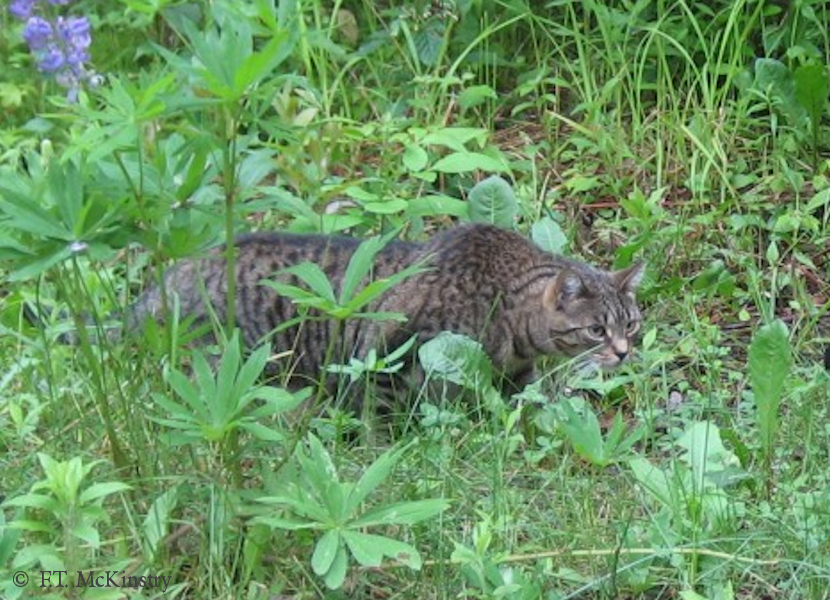
Ahh…cats. A writer’s best friend. Splendid traits aside, it’s always best to remember that cats are, at the end of the day, predators capable of wicked things indeed. I live in the woods; I have three cats that are prodigious hunters and one that can climb thirty feet into a tree without catching a breath. There is nothing romantic about this, even to a seasoned cat lady. I’ll spare you the horror stories.

River

River the Tree Climber

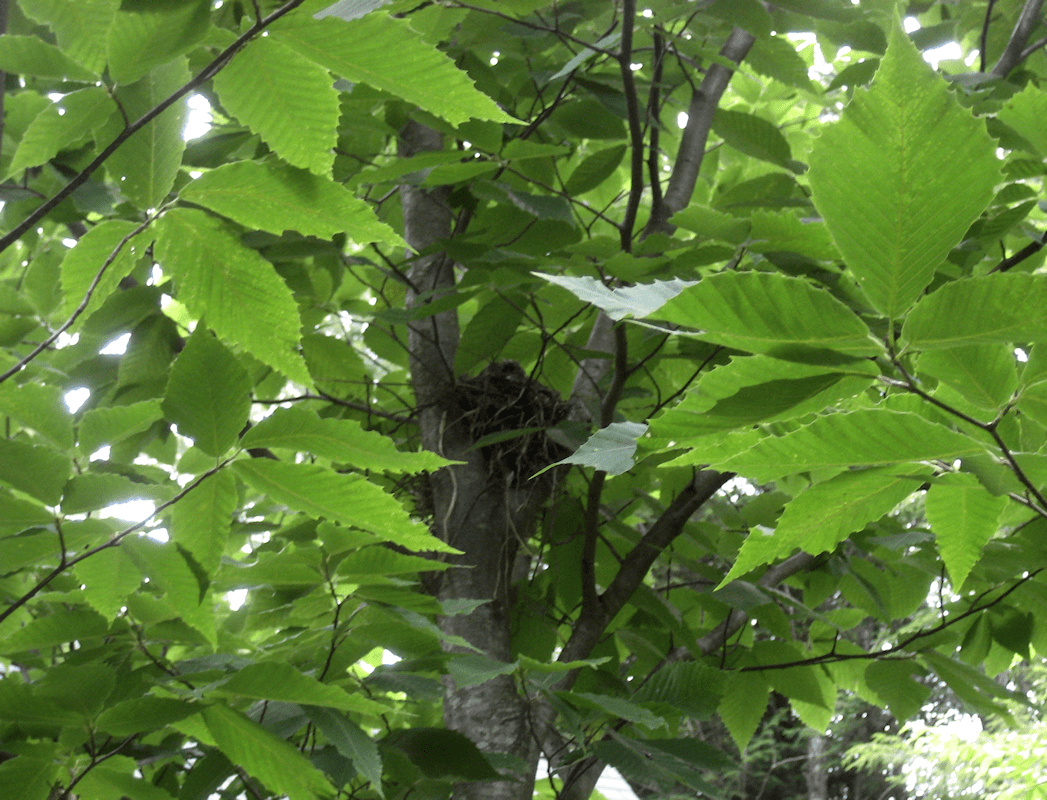
This spring, a robin built a nest in a beech tree by the house. It’s a beautiful thing. From the windows we can hear the chicks twittering and rustling around in the nest. As they’re being fed, they make a lovely, hopeful sound rich with the sort of high-pitched frequencies to which cats are particularly sensitive. In this picture you can see one of the chicks at the top of the nest. It was difficult to get a good shot without doing something obnoxious involving a ladder. I didn’t go there. The adult robins yelled at me from the trees as it was.

Robin's Nest

Robin’s Nest in the Beech Tree

Hemlock and the Cat Thwarter

Hah! Thwarted.

Needless to say, these little beggars were in serious danger (again, speaking from experience, here) so we had to do something. An old tomato cage and a wire cutter did the trick. I have affectionately dubbed this the “Cat Thwarter.” (Yes I made that word up but it works: something that thwarts.) Here it is, with my cat Hemlock lurking in flagrante delicto nearby.

So far so good. Cats. Wicked creatures.


Little Tree, by F.T. McKinstry

More Cat Posts…

Yoga Crasher
Hemlock and Editing
Puss in Books

 
© F.T. McKinstry 2014. All Rights Reserved.

Puss in Books

Puss in Boots

Le Chat Botté (Puss in Boots) ~ Gustave Doré

“When a man loves cats, I am his friend and comrade, without further introduction.’ ~ Mark Twain

Hello, my name is Faith and I’m one dead mouse away from being a crazy cat lady.

It’s been said that cats lend themselves particularly well to writers. There’s something comforting about the presence of a cat, a divine connoisseur of languor and solitude. Cats are a soft touch in the void.

And writers of fantasy? Now we’re talking Muse. Cats are mysterious and reputed to prowl the boundaries of the Otherworld. Here cats can talk, do magical things or act as gods. They serve witches, wizards, even warriors. They provide beautiful metaphors for grace and implacability—just watch a cat stalk and kill some hapless creature. Exemplary.

Stalking Hemlock

Hemlock

As I can no more pass up this tempting morsel than a cat could ignore a little bird hopping on the windowsill, following are some cats that appear in my books and stories….

Sele is kept by the sailors of a merchant vessel called The Slippery Elm. They consider her good luck at sea. When a brooding assassin named Lorth secures passage, the sailors are counting on Sele to protect them. But cats have their own agendas. She forms a bond with Lorth, who likes animals, and keeps him company over his journey.

Radu

Radu

Scrat is inspired by a cat I once had named Radu. In classic style, Scrat belongs to a wizard. He does not employ her as a familiar or an Otherworld guide, but as a mouser and a friend. Scrat is later adopted by Lorth and comforts the assassin as no human can.

Mushroom rules the garden of a young woman named Tansel, who lives alone in the mountain forest of Loralin. When she and the cat are taken in by a powerful old wizard with some dark secrets, Mushroom has his work cut out for him. While prowling after a female in heat, Mushroom attracts the attention of a winged immortal predator set on Tansel’s heart. The cat flees like a ghost when things get ugly, of course.

Oona

Oona

Rosemary does more than catch mice, cause trouble or warm a wizard’s lap. She can sing to the stars, draw down the light and heal things. She can make caterpillars drop from a plant, knit the leg of a lame horse or bring a warrior from the brink of death. In one story, she helps a witch reclaim her humanity.

Little Tree, by F.T. McKinstry

Sele and Scrat appear in The Hunter’s Rede, a story of one warrior’s transformation by the forces of war, betrayal, wizardry and love.

Mushroom appears in The Winged Hunter, a story of the perils of innocence, an immortal hunter’s curse and the long shadows of powerful wizards.

Rosemary appears in “Eating Crow,” a short story in the collection Wizard, Woods and Gods.

© F.T. McKinstry 2013. All Rights Reserved.

Old Mother Void

I found a little snakeskin in my woodpile yesterday. Well, what was left of it, anyway. A woodpile is a rough place—which, of course, is why the snake went there to perform its sacred ritual. Like a wild-eyed crone in a fairy tale, I gingerly gathered up the papery skin and put it in a safe place. You know, in case I need it some day.

The timing of this discovery is worth noting. In traditional animal lore, the snake is revered as a creature of transformation and rebirth, symbolized by the periodic shedding of its skin. A passage through the Dark Night, the Void, this process is part of all life, from the tiniest seed to the universe itself. In the wheel of the seasons it is honored as All Hallows Eve, when the veils to the Otherworld are thin and the living mingle with the dead. This is a time to acknowledge Old Mother Void and to make friends with creatures that tread the ‘tween paths without fear.

River Prowling, by F.T. McKinstry

The Old Mother has a tendency to cast a chill on the hearts of mortals. Hers is the prickle on one’s spine when wind whispers in the chimney; the cold, crushing tide of grief; the chasm a writer stares into while waiting for the words; or the visceral knowledge that it’s time to release something that no longer serves. And yet, while implacable, the Old Mother does have one’s best interests at heart. After all, the snake doesn’t fear as it slithers into a dark woodpile to shed its skin.

So I’ll keep my creepy little snakeskin, thank you, to remind me of that. Heh.

Ribbon Snake, by F.T. McKinstry

 
© F.T. McKinstry 2013. All Rights Reserved.

Eaglin of Ostarin

Eaglin of Ostarin

In the world of Ealiron, gods walk among mortals, though they are rarely seen and do not tend to concern themselves with mortal affairs beyond knowing themselves through their creations. One exception is Eaglin, the mortal son of Ealiron himself, a god who made love to Eaglin’s mother as a dream. Trained from birth by both gods and wizards in the arts of magic, war, and the old powers, Eaglin belongs to the Order of Raven, the highest order of wizards in the land. He also serves as a high priest to the Old One, the divine feminine force of cycles, birth and death.

Although Eaglin lives among mortals and knows the seasoned wisdom of animals, forests, stars and lovers, he is a solitary creature whose heart belongs to no one. By his stature, he bears the temperament of the sea: vast, powerful and unpredictable.

Eaglin is a master of shapeshifting. In the following excerpt from The Winged Hunter, he has been asked to track down a witch named Aradia, who has been hiding in animal forms for years to elude an immortal predator bent on destroying her. Finding her is one thing; returning her to human shape, another.

Little Tree, by F.T. McKinstry

Excerpt

Eaglin lowered his head and stepped back, pulling his airy cloak around his body like a wing. He knelt and spoke a word in Aenspeak to invoke the spirit of a mountain cat. A swift, agile hunter, the cat knew the paths to the Otherworld. His mind flowed into the boundaries of the hall, held in Caelfar’s spell. A wild rush of impressions spread before him, a torrent of sadness, color and song, each person, creature, tree and plant alive and suspended in a sea of light. He studied the glimmering patterns until his mind stilled on an anomaly, a pattern of one thing beneath another in an unnatural combination of energies.

He changed. His consciousness erupted into a fluid expanse of sight, scent and sound. In a single bound, he leapt to the top of the courtyard wall, padded on supple paws over the top to the far eastern side and dropped without a sound. Then he trotted towards the skittered pattern of Aradia’s altered form. A short time later, he slipped into an empty corridor outside of the antechamber of the Waeltower, his thick haunches flowing.

A rat scuttled along the edge of the passage. When it saw him, it stopped with a squeak–and disappeared.

Eaglin did not focus on Aradia’s form but on the pattern of something shapeshifted. He did not need words and he did not need to follow her through a succession of changes; he only needed to catch her once. He entered a circular courtyard open to the sky and ringed with elm trees. With a graceful thrust of feline power, he leapt into the air with a twist and caught a bluebird in his claws. It screeched and vanished. Eaglin landed on his feet as a man, cloaked and hooded. In cupped, closed hands, he held a hornet. He clenched his jaw as it stung him.

“Moridrun fore sarumn,” he said in Aenspeak, as if to wish the morning well, and then he threw open his hands and stepped back. Aradia tumbled to the floor.

Little Tree, by F.T. McKinstry

Eaglin appears in The Hunter’s Rede, in which he encounters a roguish assassin (Lorth of Ostarin) and a cruel warlord who drives his homeland into war.

In The Winged Hunter, Eaglin faces his shadow in the form of a diabolical immortal being that he is called upon to banish.

In The Riven God, Eaglin joins an exiled princess, a war god and the wizards of Ealiron in a war against a devious entity threatening to plunge the world into desolation.

In Raven of the West, he is caught in a love triangle that causes him to question his destiny as the child of a god.
 
© F.T. McKinstry 2015. All Rights Reserved.

Hemlock and Editing

Hemlock, by F.T. McKinstry

Hemlock

I recently came upon a series of amazing photos of animals camouflaged in their natural environments. They are very good at this. True to form, my cat Hemlock can vanish like a ghost when she’s of a mind.

So I just finished editing my latest novel. By “finished” I mean for the time being, because well, my publisher was waiting and I can only tinker with it for so long. Stephen King says it nicely: “To write is human, to edit is divine.” Yes, and I’m burnt. But while basking in the warm glow of having handed the beastie over to my editor, I had an interesting thought.

Mistakes hide in manuscripts in much the same way creatures camouflage themselves in the wilds. A missing or a wrong word is not as beautiful as Hemlock, of course. But I have to acknowledge how clever words are at hiding in seemingly harmless passages. It’s a testament to the power of the imagination that one can look at that egregious grammatical blunder sixty five times and not see it. Then suddenly, like magic, there it is sitting in the garden under the bushes.

They shapeshift too, you know. But that’s another story.

 
© F.T. McKinstry 2013. All Rights Reserved.

The Wizard’s Library

A library is a beautiful thing. It is a sanctuary of the mind, silent, looking within itself. Sometimes I figure everything we know must be in a library somewhere. But the whole is greater than the sum of its parts. There is always another book to place on the shelf.

A Wizard's Tower, by F.T. McKinstryThe idea of a wizard’s library is ridiculously romantic, conjuring up images of dark wood, labyrinthine passages, an old chair covered with cat hair and tables full of creepy things like crystal spheres, a skull, dried-up roots or a stuffed crow. Books, scrolls and pages fill every space, stacked into the vaults of a stone tower, a keep or a woodland cottage. In these books is all manner of arcane information, much of it long forgotten except to the wise.

Urien of Eyeroth, the protagonist of Raven of the West, is a wizard of the Order of Raven, the highest order in the Keepers of the Eye. One must read a great many things to become a Raven. So the story begins, with Urien sitting high in the Keepers’ Archive reading a tome that explores the intricacies of creation. The passage goes like this:

Desire gives formless identity structure in the form of conscious boundaries. These boundaries are subject to the forces of the Old One, who destroys old structures to create anew. ~ The Theory of Structure and Formlessness

Old BooksThere is nothing romantic about this. The heart has a way of disturbing the dust that settles on one’s beliefs. No matter how much a wizard knows, there are always dark places in his mind. All his books conspire against him. Said another way:

The Old One has a dark side that lurks in the hearts of those with power, scattering clear thought, blinding them to wisdom. Artfully, she lays the thorny paths of growth, leading souls into her realms to be stripped of old patterns. Thus, wisdom is ofttimes gained through folly, and light through darkness. ~ On the Nature of Water

After crossing a wicked priestess, Urien trips into an emotional, dangerous river of experiences involving an ex-lover and a beautiful apprentice. But wizards don’t tend to get away with things; they are too close to the source. Throughout the story, passages from books in the Keepers’ Archive whisper in Urien’s mind, reminding him of the things he knows—and doesn’t know yet.

There’s more to being a wizard than just reading books, unfortunately.

In the calm, deep waters of the mind, the wolf waits. ~ The Theory of Structure and Formlessness

Little Tree, by F.T. McKinstry

Raven of the West, a tale of desire and deception told on a fairy-tale landscape of arcane texts, herbal lore, visions and disasters at the hands of the powerful.

© F.T. McKinstry 2013. All Rights Reserved.